
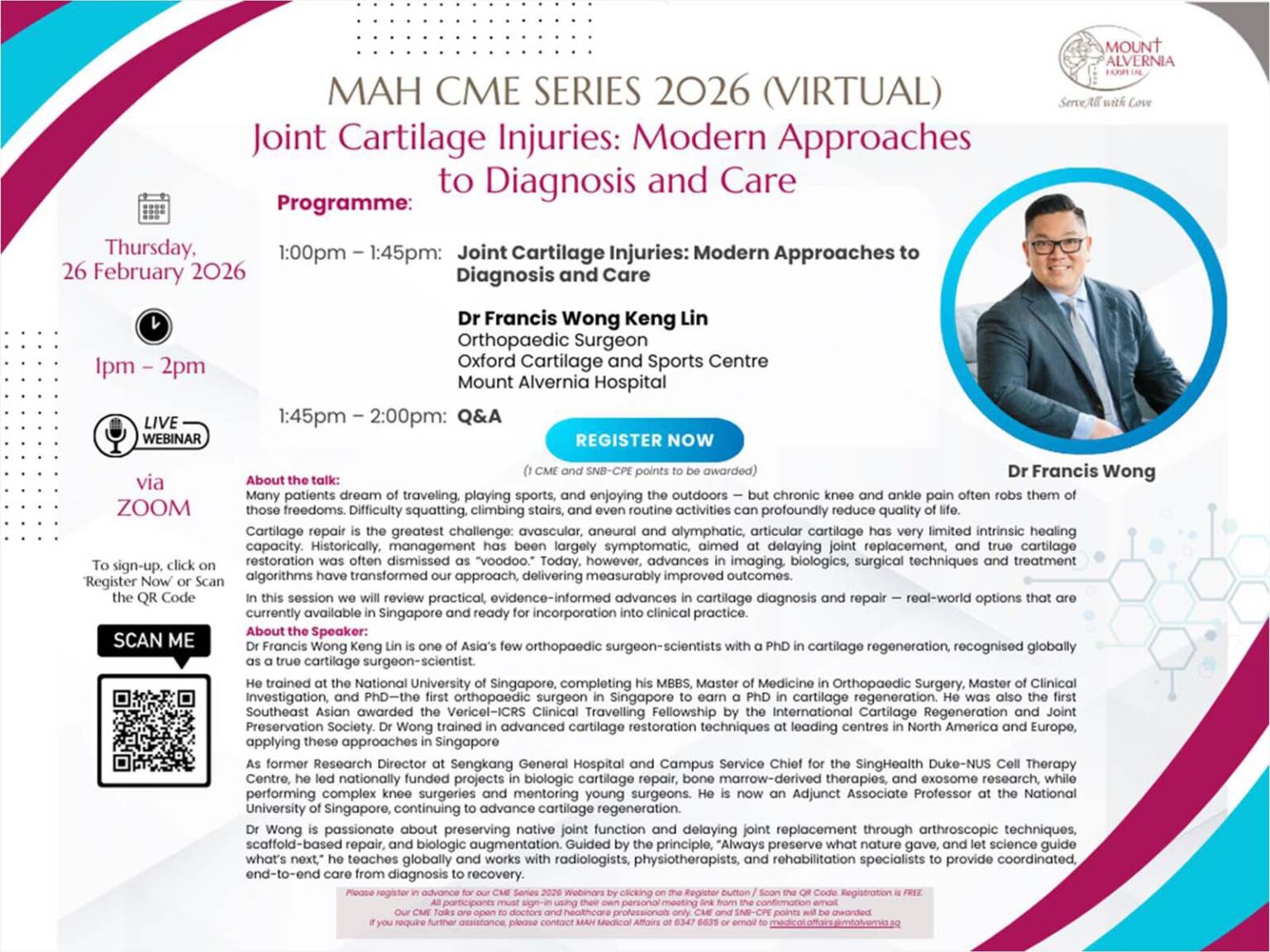
Cartilage injuries present a distinctive challenge in orthopaedic practice. Although treatment options have advanced in recent years, decisions in this area still depend on a clear understanding of joint mechanics and the biological limits of cartilage healing. Managing these injuries therefore requires careful judgement rather than a single fixed treatment pathway.
Because treatment decisions can vary depending on how injuries present and how joints respond, maintaining consistency in practice depends on regular professional exchange. As new techniques continue to emerge, clinicians must continually interpret how these developments apply in real clinical situations. Continuing Medical Education (CME) sessions provide a structured setting where this exchange can take place, allowing experience and evolving evidence to be considered together and helping clinicians keep practice aligned with current thinking.
With this in mind, Dr Francis Wong Keng Lin delivered a CME session on 26 February 2026 as part of the Mount Alvernia Hospital CME Series 2026. Titled Joint Cartilage Injuries: Modern Approaches to Diagnosis and Care, the virtual session focused on understanding cartilage injuries, their healing potential, and current approaches to cartilage repair and joint preservation.
Modern Approaches to Cartilage Injuries
The session began with a review of the basic principles behind cartilage injuries and their healing potential, establishing the biological foundations that influence treatment decisions. Understanding these principles helps explain why cartilage repair has historically been viewed with uncertainty, particularly during earlier periods when limited understanding of basic science, indications, and implant options led some to regard cartilage surgery as unreliable or “Voodoo Nonsense!”.
Building on this perspective, Dr Francis Wong discussed how modern cartilage treatment depends on looking beyond the cartilage defect alone. The focus of treatment often lies in understanding the overall joint environment and the factors that influence healing, rather than treating cartilage as an isolated structure.
The session then examined the challenges involved in assessing cartilage repair outcomes in current practice, including the role of advanced imaging techniques such as cartilage T2 mapping. Case examples were used to illustrate how cartilage repair techniques are applied in real clinical settings and how imaging findings are interpreted alongside clinical outcomes.
By linking cartilage repair techniques with clinical correlation, as well as current evidence and international guidelines, the session provided a practical overview of how cartilage injuries are evaluated and managed in modern orthopaedic practice.
Strong Professional Interest
The session drew strong interest from the professional community, with more than 800 healthcare professionals registering for the virtual CME session, including specialists, general practitioners, nurses, and other allied healthcare professionals.
As the session progressed, numerous clinical questions were raised across a wide range of practical concerns. These included questions on recognising cartilage injuries in clinical practice, interpreting imaging findings, treatment options such as injections and surgery, and the course of recovery after cartilage repair. The breadth of discussion reflected the different clinical perspectives present and the practical uncertainties clinicians continue to encounter in this area.
Working through these questions allowed current approaches to be examined in greater depth than formal presentations alone. Through sessions such as this, Dr Francis Wong continues to share his experience in cartilage injuries, as well as cartilage repair and regeneration with fellow clinicians, offering practical perspectives drawn from clinical practice and helping bring current approaches into clinical care where relevant.
