
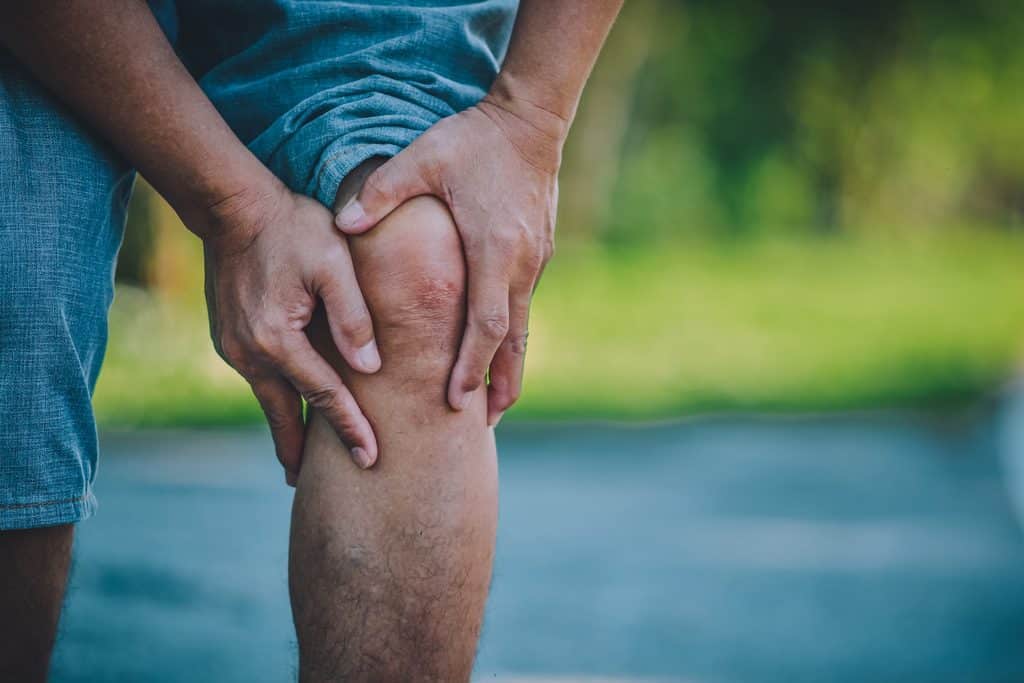
It only takes a single instance to injure a knee when playing sports. On the football pitch, this moment could be a late tackle from an opponent that catches your knee at an awkward angle. On the tennis court, it could be a lunge for a wide ball that sends your knee the wrong way. On the slopes during a skiing holiday, it could be a fall that twists your leg beneath you. Whichever way it happens, the pain is sudden and sharp, and you’re soon on the ground, clutching your knee and knowing something isn’t right. Instead of the next game or trip, your calendar might fill up with an MRI scan, possibly surgery, and weeks or months of rehabilitation.
If this sounds familiar, and you’ve since fought your way back, it’s natural to want to file the whole episode under ‘done’. But your joint might not have got the memo. This is because the injury can increase the chance of osteoarthritis (OA) developing in the same joint, sometimes years later, in what’s known as post-traumatic arthritis (PTA). And as PTA starts with an injury rather than building up with age, it can develop earlier in life than other forms of OA, even while you’re still playing. If your dream is simply to stay in the game, this year’s World Arthritis Day theme, “Achieve Your Dreams”, might strike a chord. Observed on 12 October, the day is a fitting time to understand what an injury does to the joint in the first place.
How a Sports Injury Can Raise the Risk of Arthritis
A knee injury doesn’t always stop at a torn ligament or meniscus. The same twist or blow can also damage the articular cartilage, the smooth layer covering the ends of the bones. This layer is poorly equipped to repair itself: it has no blood supply to bring in healing cells, and its own cells, called chondrocytes, are few and held in place, so they can’t move to where they’re needed. This means even a small patch of damage can remain long after the rest of the injury has settled. And as cartilage has no nerves either, this might not hurt, so your knee can feel recovered even when the cartilage hasn’t.
Beyond the moment of injury, the way the knee carries load can also affect cartilage that came through unscathed. If a ligament no longer holds the knee steady, the joint can shift abnormally or even give way, exposing some areas of cartilage to stresses they aren’t used to. The meniscus, the cushion between the thighbone and shinbone, plays a part too, as it normally spreads force across the joint. When part of this cushion is torn or removed, the force can become concentrated on the cartilage it once helped protect, which then takes more of the impact with every step and landing.
And over the years, whether from lasting damage or added strain, the cartilage can soften, fray, and thin. Alongside this, the bone can thicken beneath it and grow spurs called osteophytes at the joint’s edges, while the synovium, the membrane lining the joint, can also become inflamed. This is why OA is now seen as a condition of the whole joint. Unlike the cartilage, the bone and synovium can register pain, so they tend to be where the first signs come from.
Signs an Old Injury Is Still Affecting Your Joint
If you train regularly, these first signs can be hard to tell apart from the usual soreness after a tough session. Because the underlying changes build slowly, they tend to start mildly and come and go with your activity levels. And with the injury now years behind you, it’s easy to put them down to a heavy week or simply getting older. But recognising them early can open up options for protecting the joint while you’re still active.
Some signs to look out for include:
- Pain with activity – A deep ache might build the more you use the knee, as the bone beneath the cartilage comes under strain.
- Swelling – The knee might also look puffy or feel tight, as the inflamed synovium produces excess fluid, known as an effusion.
- Stiffness – After sitting or sleeping, the knee might be harder to bend or straighten fully until you’ve been moving a while.
- Crackling or grinding – Known as crepitus, this is often harmless, but alongside pain or stiffness, it can reflect changes in the cartilage surface.
- Catching or locking – A loose cartilage fragment or a torn piece of meniscus might slip between the bones and jam the knee mid-movement.
- Giving way – The knee might buckle or feel about to, which can suggest the joint isn’t as stable as it once was.
Should any of the above persist or start to limit your training, they might point to an old injury that’s still affecting the joint, or to an unrelated problem. Even if your knee was assessed by a specialist at the time of the injury, it could have changed since, and with it, the care it needs.
Preserving the Joint After a Sports Injury
What a fresh review finds then guides how the joint can be protected. The more cartilage that’s still intact, the more there is to work with. But whatever the result, the aim stays the same: joint preservation, which means keeping your own knee working for as long as possible and delaying or avoiding the need for a replacement.
In practice, this might involve:
- Exercise and load management – Strengthening muscles around the knee, adjusting training load, and bracing the joint where needed can ease strain on the cartilage.
- Injections – Lubricating or biological injections might help relieve joint pain in selected cases, but they don’t rebuild cartilage that’s been lost.
- Cartilage repair – By stabilising damaged areas, smoothing irregular surfaces, and reducing uneven stress, cartilage repair can help prevent breakdown of what’s still healthy around it.
- Cartilage regeneration – Biological techniques aim to encourage the affected area to regrow tissue that matches the original surface as closely as possible.
- Stabilising the knee – Where a torn ligament causes the knee to give way, reconstruction can steady it and lower the chance of further episodes.
- Meniscus repair or transplant – Where the meniscus is torn or largely lost, repair or transplantation can allow load to spread across the joint again.
- Realignment – Where the leg’s alignment overloads one side, an osteotomy can reshape the bone to shift load towards the healthier side.
While these options can’t undo everything an old injury has done to a joint, they might help protect the cartilage that remains and lower the risk of arthritis developing or advancing. As some knees need more than one method of care, choosing the right approach usually calls for an orthopaedic specialist experienced in cartilage regeneration and other joint preservation methods.
Unsure Whether an Old Injury Is Behind Your Joint Pain?
How the knee feels isn’t always a reliable sign of whether arthritis has started to develop. This is because changes in the joint can progress for some time before it starts to ache. And even where the old injury turns out to be responsible, what’s driving these changes can differ, whether it’s an area of damaged cartilage, a torn ligament that’s left the knee unstable, or a meniscus that’s lost some of its cushioning. Each of these is managed differently, so symptoms that keep returning are better assessed than played through.
At Oxford Cartilage & Sports Centre, this assessment begins with a review of your original injury and how your knee has felt since, followed by a physical examination. If imaging is needed, X-rays can reveal changes in the bone, while an MRI scan can show the state of the cartilage, meniscus, and ligaments. With this clearer picture, Dr Francis Wong can then advise on which options suit your knee. So if pain, swelling, or stiffness is making it harder to stay in the game, please contact the clinic to book an appointment.
