
In the first part of this discussion, I focused on the threshold question: when surgery should even be considered for a knee cartilage injury. Once that question has been addressed, the next layer of decision making is different. The issue is no longer simply whether the cartilage needs treatment, but what kind of treatment best fits that knee, that injury, and that patient’s goals.
This is where cartilage care becomes highly bespoke. A repair or regeneration procedure can’t be chosen by looking at the defect alone, or by selecting the newest technique available. The decision has to take into account whether the joint environment can support recovery, whether the patient can meet the rehabilitation demands, and whether the treatment plan supports return to football without losing sight of longer-term joint health. Choosing the right cartilage treatment is therefore not just a technical decision. It’s a clinical judgement about fit, timing, and whether the knee can support the result we are asking it to achieve.
Why the Whole Knee Environment Matters
One of the lessons cartilage surgeries teaches you is that the defect is never the whole story. Most of the time, the cartilage defect is the consequence. The cause is commonly something else, like a ligament or meniscus tear with instability. A repair might be placed exactly where it needs to be, but it still has to live inside a knee that loads, twists, absorbs impact, and eventually returns to sport. If that knee remains unstable, if the meniscus isn’t functioning well, or if alignment keeps directing pressure through the same injured area, the repair is placed under stress from the start.
This is why I pay close attention to the structures around the cartilage before deciding on the repair strategy. The meniscus helps distribute load across the joint. The ligaments help control the knee when a player cuts, lands, or changes direction. Alignment affects where pressure passes through the knee with each step. Strength and movement control influence how safely load is reintroduced during rehabilitation. These details might appear separate from the cartilage defect, but in practice, they often determine whether the repair is being repeatedly challenged or protected.
Once those details are understood, the treatment plan becomes more precise. Some knees may be suitable for cartilage repair alone. Others may need problems such as instability, meniscus damage, alignment, or abnormal loading to be addressed either before or alongside the cartilage repair. Otherwise, the surgeon may treat the damaged surface while leaving the forces that damaged or overloaded it largely unchanged. This is when a procedure can be technically correct but clinically incomplete.
Choosing the Right Cartilage Treatment
Once surgery is being considered, the decision becomes more specific. The question isn’t which cartilage procedure sounds most advanced, but which treatment is appropriate for that particular defect and that particular goal. Part 2 of the ICRS-FIFA-Aspetar consensus looked at this second layer of decision making by assessing different surgical procedures for symptomatic cartilage lesions in football players, taking into account lesion location, defect size, bone involvement, and whether the player placed greater priority on a quicker return to play or longer-term results.
The distinction matters because different priorities can lead to different treatment discussions. A player who needs a quicker return might not approach the problem in the same way as someone whose main concern is longer term joint preservation. In the consensus, debridement with orthobiologics was more often considered appropriate when quicker return to play was prioritised, while regenerative procedures were more often considered appropriate when longer term results were prioritised. This doesn’t mean one approach is simply better than another. It means the goal has to be clear, and the treatment has to match it.
Once that direction is clear, the same discipline has to carry into the operating theatre. Cartilage surgery isn’t only about choosing a procedure before the operation begins. It’s also about judging the quality of the cartilage edge, the condition of the base, how much tissue should be prepared, what should be preserved, and when doing more might not mean doing better. Where marrow access or defect preparation is part of the treatment, that judgement becomes even more important because the surgeon has to create the right biological response without causing unnecessary damage. In cartilage care, the wrong procedure can be as much of a problem as the wrong indication. The aim isn’t to do the most, but to prepare the defect properly, preserve stable cartilage, and stop once the joint has what it needs to heal.
Return to Football Isn't Just About Time
The discipline used in choosing the cartilage treatment has to continue into the return to football plan. Once a repair or regeneration procedure has been performed, recovery isn’t simply a countdown. The treated area has to mature, the knee has to remain quiet as load increases, and the player has to rebuild the strength and control needed to move confidently again.
This is why I don’t clear return to play by time alone. I look at how the knee responds when rehabilitation becomes more demanding: whether swelling returns, whether pain stays controlled, whether movement quality holds up, and whether the player can trust the knee through faster, less predictable tasks. These details matter because a knee can feel improved before it’s ready to tolerate the full rhythm of football.
Return to football should therefore be staged rather than rushed. Rehabilitation load comes first, followed by controlled football specific work, then more reactive drills, then training exposure before match play is considered. At each stage, the knee has to earn the next step by staying settled and functioning well. The aim isn’t just to get the player back onto the pitch, but to return with a knee that has been properly prepared for the demands placed on it.
When Should Knee Pain Be Assessed?
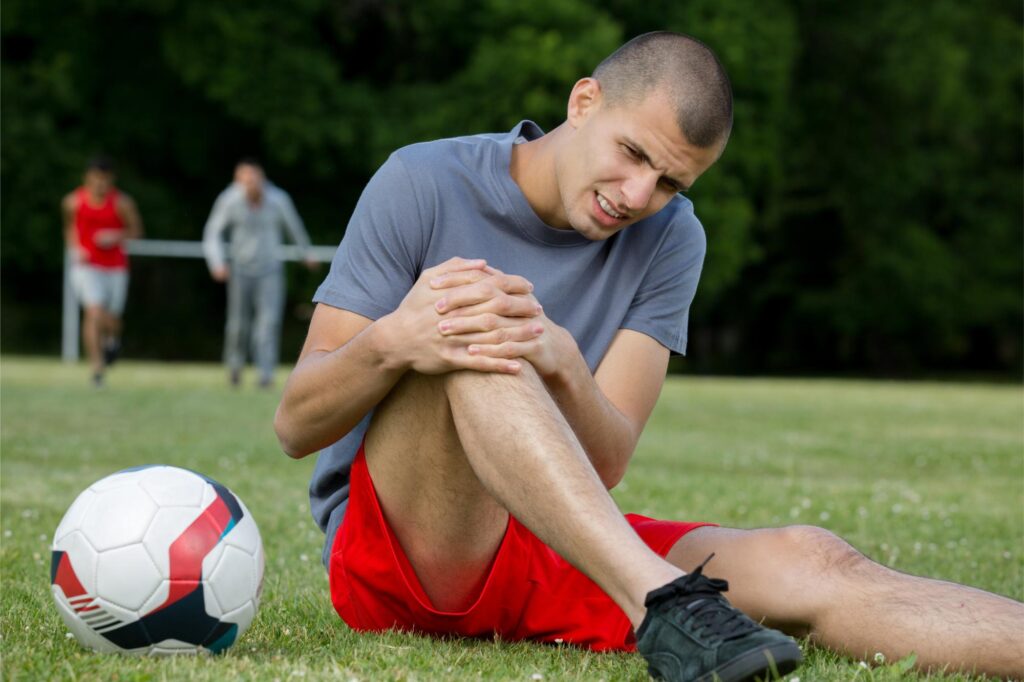
A knee doesn’t need to fail dramatically before it deserves assessment. In football, the more useful clue is often the pattern that appears after load. If swelling keeps returning after training, if knee pain develops after play, or if the joint catches, locks, gives way, hurts with pivoting, or starts to feel unstable during movement, the question is no longer whether the player can get through another session. The question is why it keeps reacting each time football load is reintroduced.
The distinction matters because these symptoms rarely fall neatly into one category. Cartilage, meniscus, ligament control, bone response, alignment, strength, and loading can all influence how the knee behaves when football load increases. This is why cartilage care shouldn’t be driven by fear, guesswork, or the assumption that a scan finding automatically points to a particular procedure. The right treatment comes from understanding what’s actually injured, what the defect demands, what the patient is trying to return to, and whether the wider knee environment can support recovery. This is where cartilage-specific judgement matters: in separating what looks treatable from what the knee can actually support.
