
Orthopaedic surgery is advancing rapidly. Techniques evolve, biologics develop, and new data is published at pace. Yet progress only holds meaning when surgeons can interpret evidence with clarity and judgement.
This ability isn’t developed by chance. It’s trained. Evidence Based Medicine (EBM) provides the framework. At its core, EBM is the disciplined process of evaluating research, understanding statistics, and applying the best available data to real clinical decisions.
Preparing the Final Year Residents
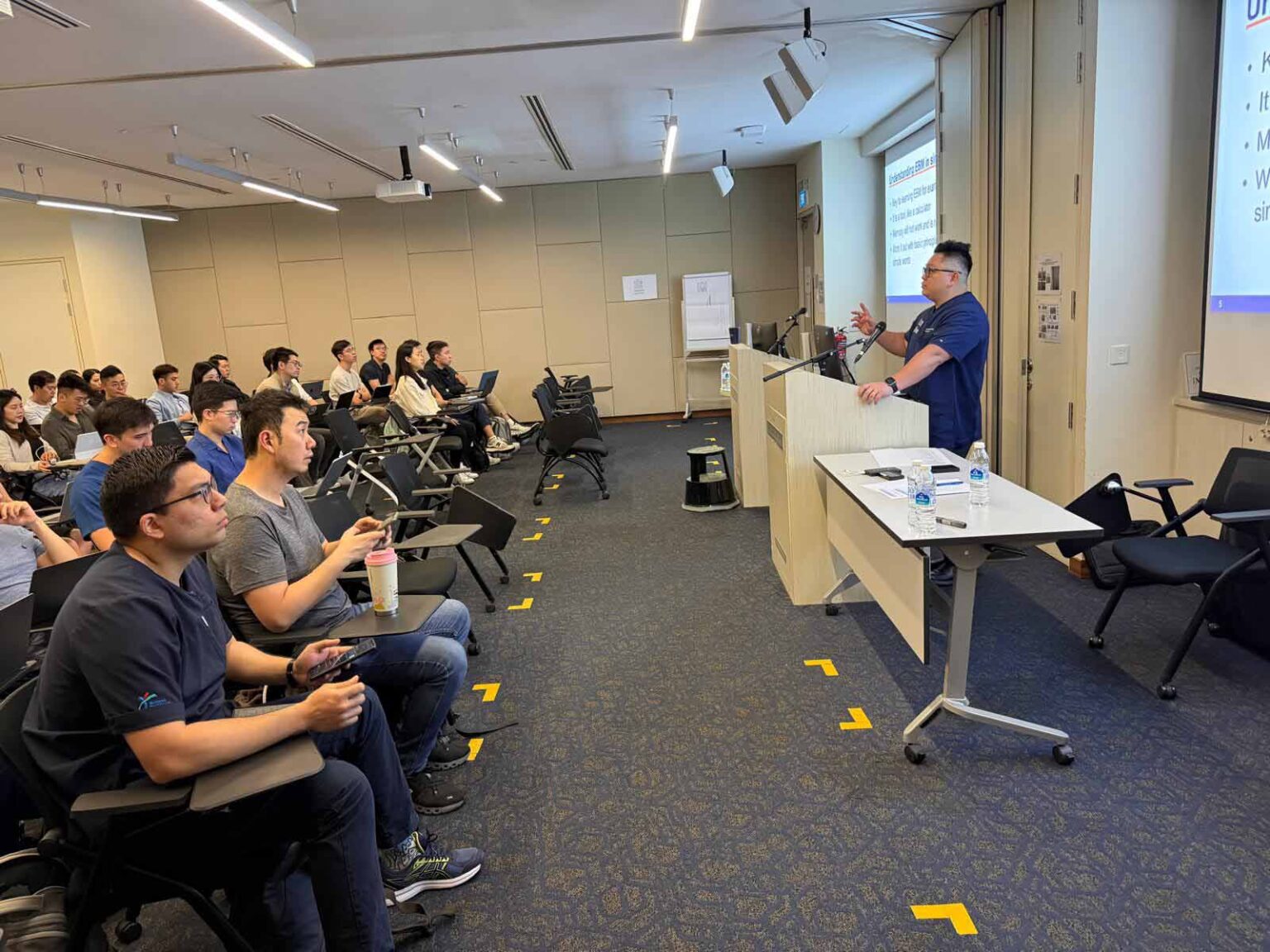
On 12 February 2026, this discipline formed the focus of a session led by Dr Francis Wong Keng Lin at the Singapore Fellowship of the Royal Colleges of Surgeons (FRCS) Preparatory Course 2026, conducted under the National University of Singapore (NUS) Yong Loo Lin School of Medicine. The course brought together final year orthopaedic residents from Singapore and Hong Kong preparing for their Exit and FRCS examinations.
The session began with fundamentals before building into deeper interpretation. Sensitivity and specificity were examined in relation to clinical prevalence. Predictive values were discussed in practical terms at the bedside. Bias, confounders, survival analysis, and outcomes data were then analysed step by step. Rather than relying on memorised formulas, residents were expected to reason through data clearly and justify their conclusions under examination conditions.
Applying Evidence in Modern Orthopaedic Practice
This discipline is central to modern orthopaedics. Advances in biologics, cartilage restoration, and joint preservation continue to expand what is surgically possible. In Dr Francis Wong’s work at Oxford Cartilage & Sports Centre, where regenerative strategies form a key part of treatment, rigorous appraisal of evidence directly informs patient selection and procedural decisions. Innovation must be matched by judgement.
Continued Faculty Leadership and International Contribution
That same emphasis on disciplined thinking underpins Dr Francis Wong’s longstanding involvement in postgraduate education. Since 2018, he has served as a core faculty member of this programme, guiding successive cohorts as they prepare for specialist accreditation and eventual independent practice. His leadership in training also extends internationally through his role as Deputy Chair of the NextGen Committee of the ICRS – International Cartilage Regeneration & Joint Preservation Society, where he contributes to the shaping of standards for the next generation of orthopaedic surgeons globally.
At this level, teaching reflects more than experience. It reflects trust, standing, and influence within the specialty. As orthopaedics continues to advance, surgeons who combine technical excellence with disciplined interpretation of evidence will define its future, and Dr Francis Wong continues to play a central role in exacting that standard.
